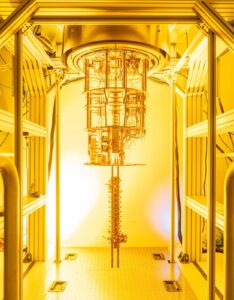
The Department of Energy (DOE) on Sept. 17 announced the Quantum Genesis Q Competition, a $215 million initiative to fund private-sector teams racing to build the world’s first fault-tolerant, scientifically relevant quantum computer. Structured as a milestone-based competition rather than a conventional grant, it will pay out fixed awards of up to $1.5 million per team for early technical milestones, then split a $100 million pool—plus two $50 million bonus pools—among teams that can demonstrate machines with 100, 150, and 200 logical qubits, respectively. Applications, open to any private-sector team, are due Oct. 19.
Under Secretary for Science Dr. Darío Gil framed the effort in sweeping terms on a press call previewing the announcement. He likened the effort to earlier generations of major scientific instruments, such as the first particle accelerators or incredibly capable telescopes. “It’s a scientific instrument of the first kind, one that deals with one of the most fundamental building blocks of nature, which is quantum mechanics,” Gil said.
That framing—quantum computing as basic-science infrastructure, not power infrastructure—is accurate, and most of what the DOE is funding has little direct bearing on how utilities and power plant operators run their business today. But a companion report, also released today, from the Office of Science Advisory Committee’s (SCAC’s) Quantum Subcommittee, lays out a roadmap of seven “grand scientific challenges” the eventual technology is meant to tackle. Two of them sit squarely in the power sector’s own long-term problem set: fusion energy materials, and next-generation batteries and superconductors.
Fusion’s Materials Bottleneck
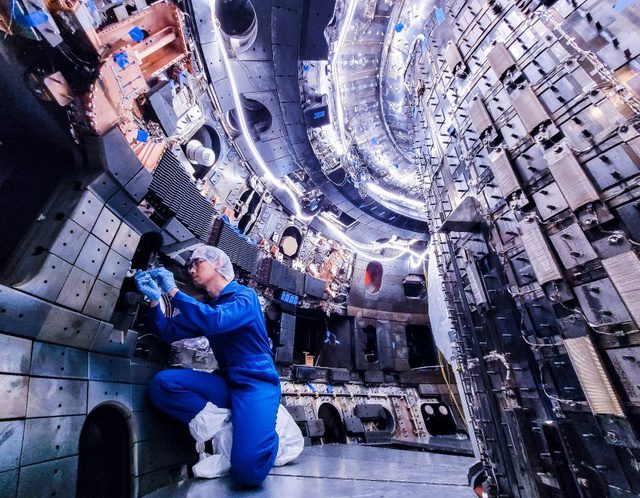
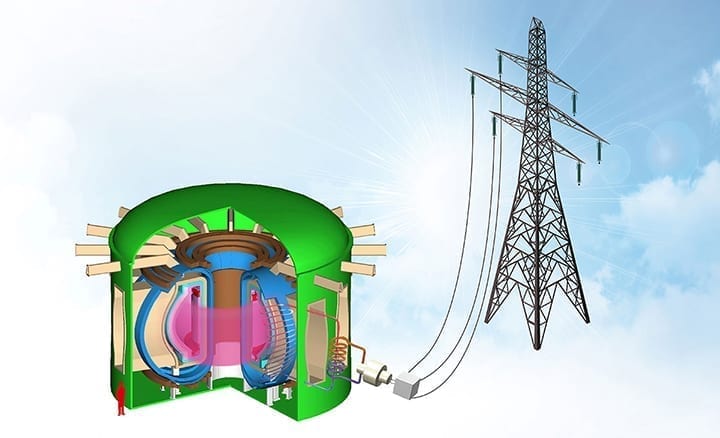
The SCAC roadmap treats fusion as one of its seven grand challenges, with milestones running from now through the 2030s. Near-term goals for 2026 and 2027 call for quantum calculations of tritium binding, plasma-response models, and material transport properties—foundational chemistry problems that today strain classical supercomputers. By 2028, the committee wants a validated prediction of “key quantities limiting fusion design.” The payoff, on the report’s 2030-and-beyond horizon, is more ambitious still: simulating integrated tritium production and recovery, plasma-facing materials, and the extreme conditions inside a reactor or target—work the report says could translate into more reliable fusion systems and a faster path to commercial fusion energy.
This isn’t purely aspirational. The report’s bibliography cites a June 2026 preprint from Oak Ridge National Laboratory, Cleveland Clinic, and IBM describing what the authors call the first known quantum computation of fusion blanket molten salts—an early, real demonstration that the approach can touch the materials fusion developers actually need to characterize.
Batteries and Superconductors, Designed Before They’re Built
A second grand challenge targets “next-generation materials and superconductors.” The near-term milestones are more modest—simulating simple materials models against known experimental results in 2026, extending to more complex correlated-materials models in 2027, and producing a validated prediction for a correlated material by 2028. But the long-term goal is the one that matters for the grid: the report envisions quantum computers eventually predicting and designing superconductors and energy-storage materials before fabrication—compressing a materials-discovery process that today runs through years of trial-and-error synthesis and testing.
A Long Runway, Not a Near-Term Deliverable
It’s worth being direct about timing. Gil was unusually candid on the press call about the odds of hitting even the base 2028 hardware milestone—a machine with roughly 100 logical qubits capable of hundreds of millions of fault-tolerant operations. “I think maybe there’s a 50% probability that it can be realized” on that schedule, he said. “What about a year later? I’ll probably increase the odds to 75%. And what about two years later? I will give it in the high 90s.”
That estimate applies to the hardware alone. The fusion and materials payoffs the SCAC report describes sit explicitly on its 2030-and-beyond horizon, a full phase past the Q Competition’s own milestones. The DOE has also been careful not to let the competition predetermine what a future national quantum user facility looks like: officials said on the call that whichever hardware modality wins the current race won’t automatically be selected for the follow-on facility, and that they expect the technology—like high-performance computing before it—to cycle through multiple architectures over decades.
When asked whether the Q Competition amounted to an audition for the eventual user facility, Gil pushed back, casting it instead as the start of an effort he expects to unfold over decades. “We see this more as the opening salvo of that journey,” he said—not the end.
For an industry watching fusion timelines and battery chemistry roadmaps for the next real breakthrough, that’s the honest way to read this announcement: a long-horizon federal bet whose materials-science payoff, if it arrives, is still the better part of a decade out.
—Aaron Larson is POWER’s executive editor.